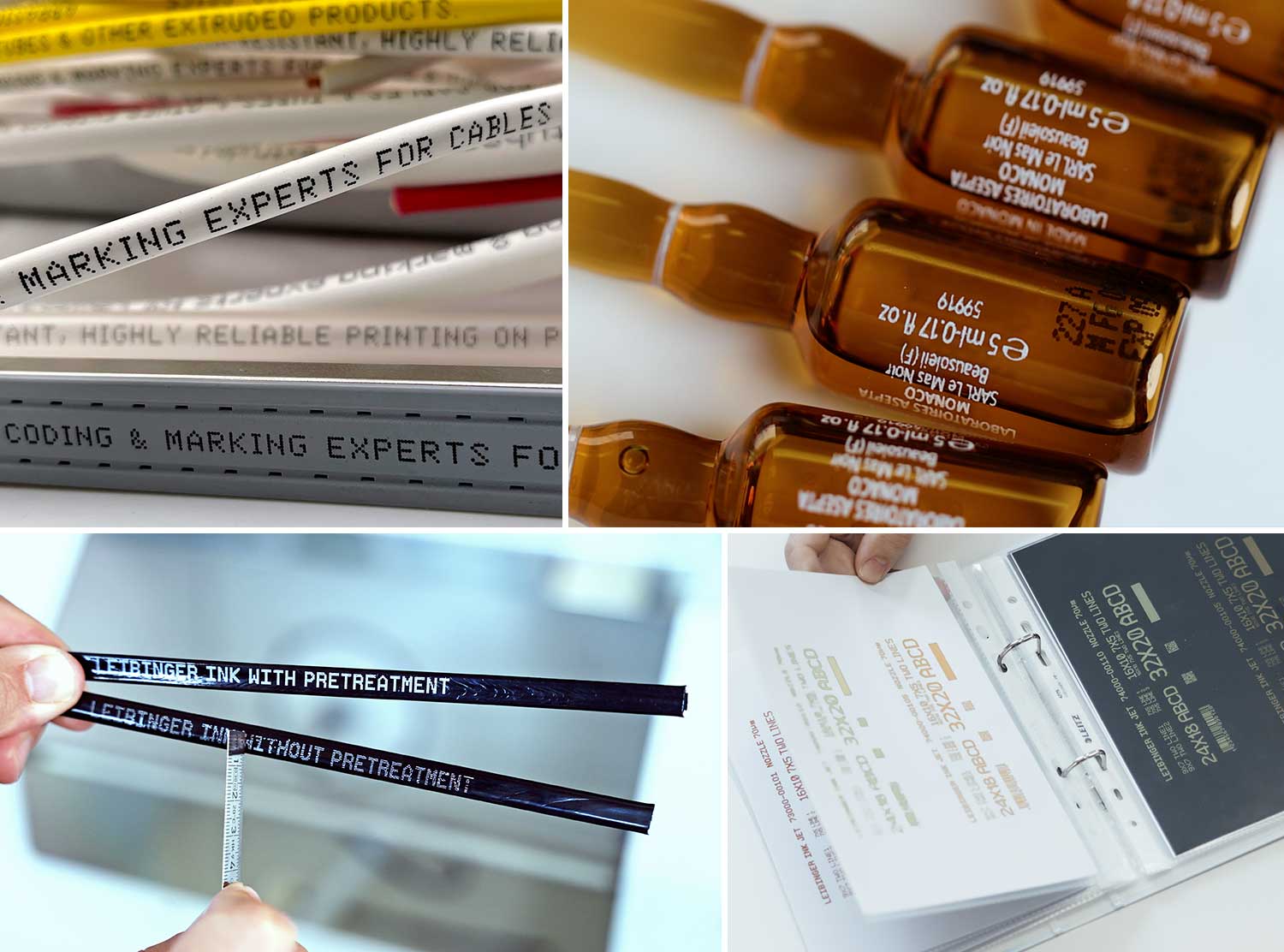

Why ink determines
CIJ success
Marking technology for permanently readable codes that adhere securely and dry quickly
In this technical article, LEIBINGER explains that achieving the best coding performance requires precise alignment of printer, ink, substrate, and production environment. This ensures a stable production line when using CIJ-based (CIJ = Continuous Inkjet) marking systems.

Innovative Technology
When companies invest in a CIJ printing system, they often focus first on the printer itself, printing speed, and total cost of ownership. Understandably. What is frequently underestimated, however, is that the ink is not simply a “consumable” – it is a critical process factor. Ink plays a decisive role in ensuring codes remain permanently readable, adhere reliably, dry quickly, and allow the production line to run stably without developing hidden issues over time.
This is relevant across industries – from food and beverage to cosmetics and extrusion applications. Changing materials, high production speeds, demanding environments (condensation, dust, heat), and increasing requirements for traceability and process reliability make ink selection a true success factor.
Furthermore, you have to consider at what speed and in what environment is being printed. Factors that influence this include line speed, temperature, humidity, condensation, and cleaning chemicals.
Finally, you need to take into account which performance requirements apply. For example, abrasion resistance, drying time, washability/removability, or special functions such as UV fluorescence or color-changing properties.
Why is this matching process so important? Quite simply: set-off, smearing, and poor adhesion are often the result of ink that is not ideally matched – or of changes in the substrate or production process.
A practical example is PVC. On rigid PVC, such as pipes, coding is often relatively straightforward. In more flexible PVC applications, such as cable insulation, plasticizers make adhesion significantly more challenging. If the ink formulation is not optimized, the risk of set-off increases considerably. This clearly demonstrates that the material name alone is far from sufficient. The exact composition of the material is what matters.
This is relevant across industries – from food and beverage to cosmetics and extrusion applications. Changing materials, high production speeds, demanding environments (condensation, dust, heat), and increasing requirements for traceability and process reliability make ink selection a true success factor.
CIJ only works when the ink and printer are properly matched
A clean CIJ print is always the result of the right combination of four factors. First, it depends on what is being printed – for example, text, logos, barcodes, or 2D codes – and what are the requirements regarding contrast and scanner readability. It’s also important to determine what is being printed on, taking into account the material class, surface characteristics, coating, and additives (such as plasticizers).Furthermore, you have to consider at what speed and in what environment is being printed. Factors that influence this include line speed, temperature, humidity, condensation, and cleaning chemicals.
Finally, you need to take into account which performance requirements apply. For example, abrasion resistance, drying time, washability/removability, or special functions such as UV fluorescence or color-changing properties.
Why is this matching process so important? Quite simply: set-off, smearing, and poor adhesion are often the result of ink that is not ideally matched – or of changes in the substrate or production process.
A practical example is PVC. On rigid PVC, such as pipes, coding is often relatively straightforward. In more flexible PVC applications, such as cable insulation, plasticizers make adhesion significantly more challenging. If the ink formulation is not optimized, the risk of set-off increases considerably. This clearly demonstrates that the material name alone is far from sufficient. The exact composition of the material is what matters.
Video: How a LEIBINGER printer comes to life
×
![]()