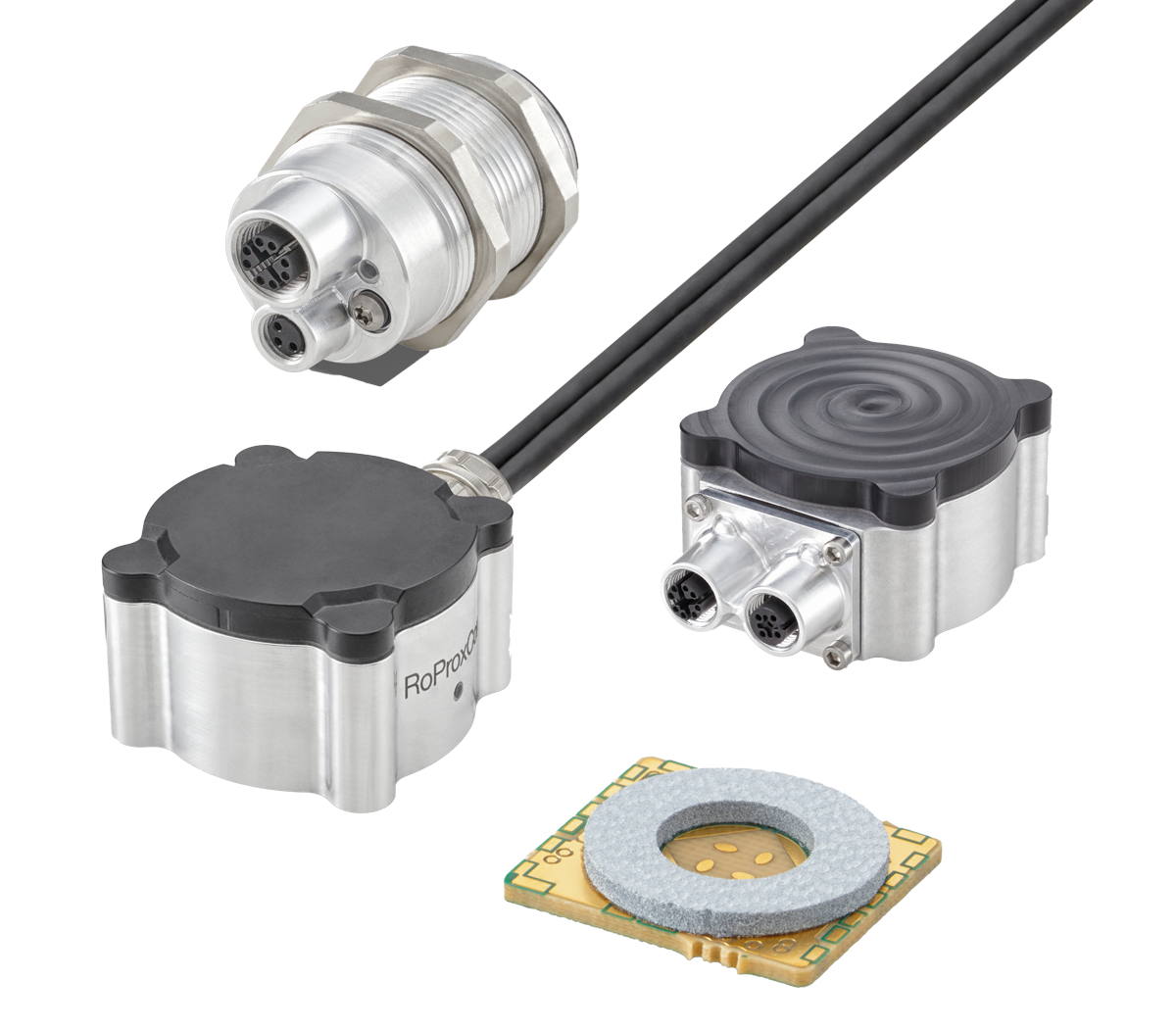
RoProxCon®:
Wear-free and highly reliable
transmission of power and data
Contactless connection systems offer a forward-looking solution here: They transmit power and data without any contact. This eliminates mechanical weak points and enables the creation of durable, low-maintenance interfaces – a decisive advantage for modern industrial applications.
Efficiency via Contactless Technologies
Contactless connection technologies increase the efficiency of industrial systems on multiple levels. Contactless transmission of power and data eliminates the need for mechanical contact points, which are typical weak points of conventional connectors and often responsible for maintenance costs and system failures. These systems operate without wear, allow for maximum freedom of movement, and are ideal for rotating or dynamic applications.
Contactless transmission systems use radio technologies in the millimeter wave range to achieve high data rates over short distances. Typically, carrier frequencies around 60 GHz with large available bandwidths are used. These bandwidths in the range of several gigahertz enable data transfer rates in the gigabit range and support the parallel connection of numerous sensors and communication interfaces. Such transmission concepts are ideal for modern manufacturing environments with high sensor and communication density.
Contactless power transmission is achieved via inductive coupling at approximately 200 kHz. The proprietary electronics operate with exceptional efficiency, generating minimal waste heat and enabling low-loss transmission of power up to 30 watts – ideal for sensors, actuators, or grippers in automated systems.