The development of plug-in connectors is heavily influenced by three trends: digitalisation,
decentralisation and miniaturisation. In decentralisation, increasing numbers of functions in the industrial
environment are shifting to the device and field level, meaning that there will be an increasing demand for
a comprehensive connection between devices along the horizontal and vertical axes of the automation pyramid.
This also includes supplementation with intelligent functions. Integrating sensor and diagnostic functions
directly into the connectors opens up completely new application fields and renders additional sensors
superfluous.
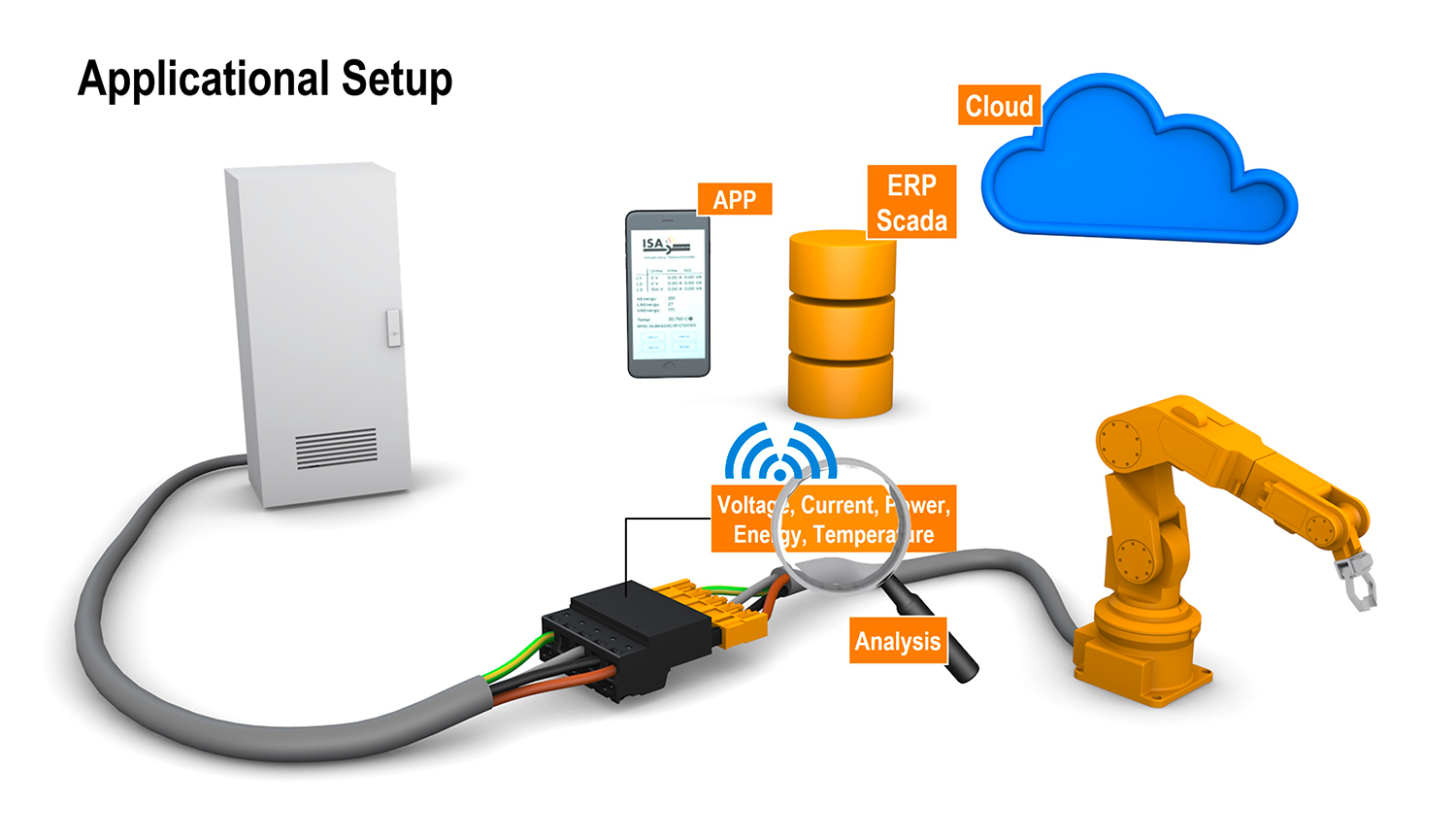
Measured variables like current, voltage, power and temperature can be measured, as well as
saved and evaluated with an app, an ERP/SCADA system or a cloud. Such an intelligent plug-in connector is
presented by Weidmüller for the first time at Hannover Messe 2019.
The smart plug-in connector was created
as part of the German Federal Ministry of Education and Research (BMBF) funded project: "Intelligent
electric plug-in connector and connection technology with electronic signal processing (ISA)".
Easy to use
Plug-in connectors and electrical connection technologies play a key role in networking tomorrow's
production. They are the main interface between machines, controllers and data processing systems and thus
form the basis for the functionality, easy handling and reliability of the automation technology. The smart
plug-in connector from Weidmüller can be located in the connecting line(s) of production facilities, modules
or islands. The plug-in connector serves for power supply, signal and data connection on the SCADA or ERP
level. In the smart infrastructure plug-in connector, the following variables are measured on the three
phases: current, voltage and power. The maximum current is 3 x 72 A. Voltage measurement is performed
directly on L1-L3, without galvanic isolation. Temperature measurement is also integrated. Of course, the
plug-in connector is matched to the industrial environment, this is reflected by the following data:
temperature range -40 °C to +125 °C, voltage: 3 x 230 V/AC, Signal frequency: 50/60 Hz. The current
measurement is achieved with Hall sensors, i.e. without interrupting the electric circuit.
The smart plug-in connector is located within the connecting line where it measures various electrical values and transmits these, e.g. to an app, cloud or to ERP or Scada systems