Networks & Security
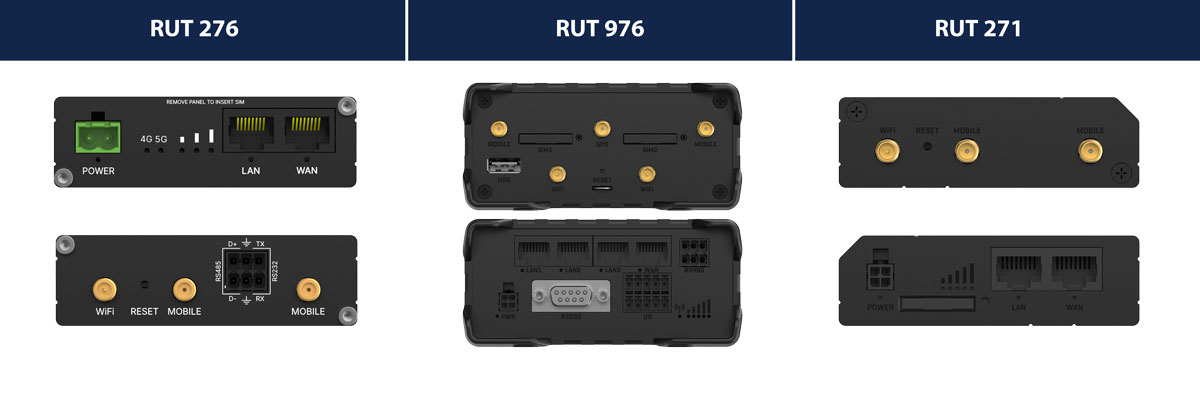
RUT 276, 271, 976 with ports for antennas, LAN, WAN, the industrial serial interfaces RS232 and RS485, and power
Unlike conventional 5G, 5G RedCap deliberately avoids complex hardware architectures and particularly high data rates. This makes end devices more energy-efficient, compact, and cost-effective. Especially in large-scale IoT infrastructures with many endpoints, this results in significant advantages in terms of operating costs, integration, and scalability.
In addition, hardware and integration costs are lower than with other technologies. Reliable and stable communication on the 5G network, lower latency compared to traditional IoT wireless technologies, and backward compatibility with existing 4G/LTE networks enable communication in industrial applications. Added to this is the future-proof migration of existing IoT solutions to 5G.
This makes the technology particularly suitable for applications with moderate data volumes where stability, availability, and efficiency are more important than maximum bandwidth.
The key benefits of 5G RedCap
5G RedCap offers reduced energy consumption, resulting in longer battery life.In addition, hardware and integration costs are lower than with other technologies. Reliable and stable communication on the 5G network, lower latency compared to traditional IoT wireless technologies, and backward compatibility with existing 4G/LTE networks enable communication in industrial applications. Added to this is the future-proof migration of existing IoT solutions to 5G.
This makes the technology particularly suitable for applications with moderate data volumes where stability, availability, and efficiency are more important than maximum bandwidth.
Ideal for industrial IoT and M2M applications
The applications for 5G RedCap are wide-ranging. The technology is particularly interesting wherever many devices need to be connected reliably and cost-effectively.Typical applications
- Industrial sensors and automation
- Smart metering and energy supply
- Logistics tracking and asset monitoring
- Digital signage and information systems
- Video surveillance with moderate data requirements
- Building automation and infrastructure applications
- Wearables and connected health devices
 Find out more now!